USA Flag Glitter: A Patriotic Design Resource for Creative Professionals and DIY Enthusiasts
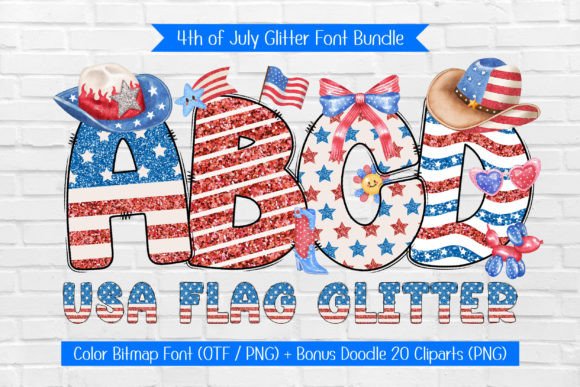
When designing for national holidays—especially the 4th of July—authenticity, visual impact, and technical versatility matter. USA Flag Glitter emerges not merely as a decorative font, but as a purpose-built design asset that bridges symbolic resonance with practical utility. Unlike generic patriotic fonts that rely on static stripes or simplified stars, this set embeds texture, dimension, and chromatic intentionality into every glyph. Its red, white, and blue glitter effects aren’t layered as afterthoughts; they’re integral to the letterforms themselves—rendered with deliberate contrast, light-refracting granularity, and balanced saturation.
How USA Flag Glitter Translates Symbolism Into Scalable Typography
At its core, USA Flag Glitter is a bitmap font family, meaning each character is crafted pixel-by-pixel at specific sizes to preserve crispness and sparkle fidelity. This approach ensures that even at small dimensions—such as 24-point text on a greeting card or 36-point heat-transfer vinyl—the glitter particles remain legible and cohesive, rather than blurring or collapsing into indistinct noise. The set includes four distinct font styles: Regular, Bold, Outline, and Shadow. Each variant serves a different compositional role:
- Regular: Ideal for clean, high-contrast applications like printable banners or digital social media graphics where readability takes priority;
- Bold: Optimized for signage, t-shirt prints, and sublimation transfers where strong visual weight anchors a layout;
- Outline: Enables creative layering—pair it with solid fills or background textures to simulate embroidered or etched effects;
- Shadow: Adds subtle depth without overwhelming, making it especially effective in poster design or layered digital mockups.
This stylistic range reflects an understanding of real-world production constraints. For example, a craft business producing custom mugs via sublimation needs fonts that align precisely with printer resolution limits and ink absorption behavior. Bitmap fonts like those in USA Flag Glitter avoid the anti-aliasing artifacts common with vector-based “glitter” fonts when rasterized—a frequent pain point for print-on-demand users.
Flexible Delivery Formats for Diverse Workflows
The USA Flag Glitter package ships with dual-format support: OpenType (.otf) files for direct font installation and use in Adobe Creative Cloud, Affinity Suite, Cricut Design Space, Silhouette Studio, and other professional or hobbyist software—and optional high-resolution PNG files (transparent background, 300 DPI) for immediate drag-and-drop integration.
This hybrid delivery model accommodates varied skill levels and toolchains. A graphic designer building a campaign for a local veterans’ organization can install the OTF and type headlines directly in Illustrator, adjusting kerning and tracking with precision. Meanwhile, a middle school art teacher preparing a classroom bulletin board might prefer the PNGs—simply inserting individual letters into Google Slides or Canva without needing font management knowledge. Educators report reduced setup time and fewer student questions about missing fonts when using the PNG option during collaborative digital projects.
Importantly, all bitmap variants are sized for optimal clarity at common output resolutions: 72 DPI for web, 150 DPI for large-format printing, and 300 DPI for fine-detail crafts like iron-on transfers or resin molds. No upscaling interpolation is required—preserving the integrity of the glitter texture.
20 Bonus Clip Art Pieces: Contextual Consistency Without Compromise
Typography rarely exists in isolation. Supporting visuals reinforce theme, guide hierarchy, and reduce the need for external asset hunting. The included 20 bonus clip art elements—each designed in the same red, white, and blue glitter aesthetic—include stars, stripes, fireworks bursts, liberty bells, eagles, and stylized “USA” monograms. Crucially, these aren’t generic stock icons. They share the same grain structure, edge treatment, and chromatic balance as the letters, ensuring visual harmony whether placed beside, above, or integrated within typographic layouts.
For example, a small-business owner creating seasonal Instagram posts can combine the “Bold” font for “INDEPENDENCE DAY SALE” with a matching firework PNG as a bullet point or corner accent—no color correction or style-matching needed. Similarly, a church youth group designing handouts for a community picnic can use the star clip art as section dividers while keeping all text in the USA Flag Glitter Outline style, maintaining a unified handmade feel across printed and digital formats.
Real-World Applications Across Sectors
The adaptability of USA Flag Glitter becomes most evident when observing how different user groups apply it—not as a novelty, but as a functional component of their creative infrastructure.
Hobbyists and DIY Crafters
Sublimation enthusiasts frequently cite alignment accuracy and glitter retention as top challenges. Because USA Flag Glitter’s bitmap construction avoids vector path complexity, it prints cleanly on sublimation paper without stray outlines or inconsistent glitter density. Users report significantly fewer failed transfers when using the Bold or Shadow variants on polyester apparel—particularly on dark fabrics where contrast and particle definition are critical.
Educators and Youth Program Coordinators
In classroom settings, accessibility and ease of adaptation are essential. Teachers use the PNG versions to build differentiated materials: students with dyslexia benefit from the high-contrast, non-serif structure paired with consistent glitter rhythm, which supports visual tracking. Others integrate the clip art into interactive PDFs or SMART Board lessons—dragging stars onto maps of Revolutionary War battles or arranging letters to spell vocabulary words tied to civic themes.
Small Businesses and Local Organizations
Chambers of commerce, farmers markets, and municipal recreation departments often operate with limited design staff and tight turnaround windows. With USA Flag Glitter, a single staffer can generate cohesive assets across channels—same font used for a Facebook cover image, a printed parade float banner, and a vinyl decal for a food truck window—all without licensing complications or format conversion delays. One regional tourism board reported cutting annual holiday campaign asset creation time by nearly 40% after standardizing on this set.
Technical Considerations and Best Practices
While USA Flag Glitter excels in usability, informed implementation enhances results. First, bitmap fonts do not scale infinitely. Attempting to stretch them beyond their native size range (typically 24–144 pt for the provided OTF builds) will degrade sparkle fidelity. Instead, designers should select the appropriate variant for intended output size—e.g., using the 72-pt build for posters rather than scaling the 36-pt version.
Second, transparency handling matters. When using PNGs in layered compositions, ensure blending modes are set to “Normal” unless intentional overlays are desired. Some users mistakenly apply “Multiply” or “Overlay,” which dulls the glitter’s luminance. Previewing at 100% zoom before final export helps catch unintended opacity shifts.
Third, consider context-driven color pairing. Though the font itself is fixed in red, white, and blue, surrounding backgrounds should complement—not compete—with its vibrancy. Deep navy or charcoal gray backdrops enhance contrast without washing out detail, whereas bright yellows or oranges may visually clash or create chromatic vibration.
Why This Resource Fits Evolving Creative Expectations
Today’s creators increasingly value assets that reflect both cultural authenticity and production pragmatism. Generic “patriotic” fonts often fall short: some lack true flag-color fidelity, others sacrifice legibility for ornamentation, and many fail to support multi-platform workflows. USA Flag Glitter addresses these gaps deliberately—not by overloading features, but by refining fundamentals. Its glitter isn’t simulated through filters or gradients; it’s built-in, consistent, and reproducible.
Moreover, its release timing aligns with broader trends in craft-based branding and localized celebration culture. As consumers seek meaningful, tactile connections to national identity—whether through handmade ornaments, personalized apparel, or community-centered events—tools like this empower creators to deliver sincerity, not just symbolism. It’s typography that doesn’t shout; it resonates.
Whether you're prototyping a new line of Fourth of July party supplies, developing curriculum-aligned classroom resources, or designing a city-wide heritage festival identity system, USA Flag Glitter functions less like a decorative add-on and more like a foundational element—one that carries intention, honors tradition, and performs reliably across media.